A blameless postmortem is a review held after an incident that explains what happened and how to prevent or reduce similar failures, without blaming the people involved. It examines the software, the information that was available, and the conditions behind each decision, then assigns concrete improvements with owners. The point is to make the system safer, not to decide who was at fault.
For TicketDesk, our fictional booking service, the review might ask why a new confirmation version caused delays, why the checks missed the problem, and why recovery took longer than expected. Each of those is a question about the system, not about a person.
If you have never written one of these, do not worry. The structure is simple once you have seen it, and this lesson walks through each part.
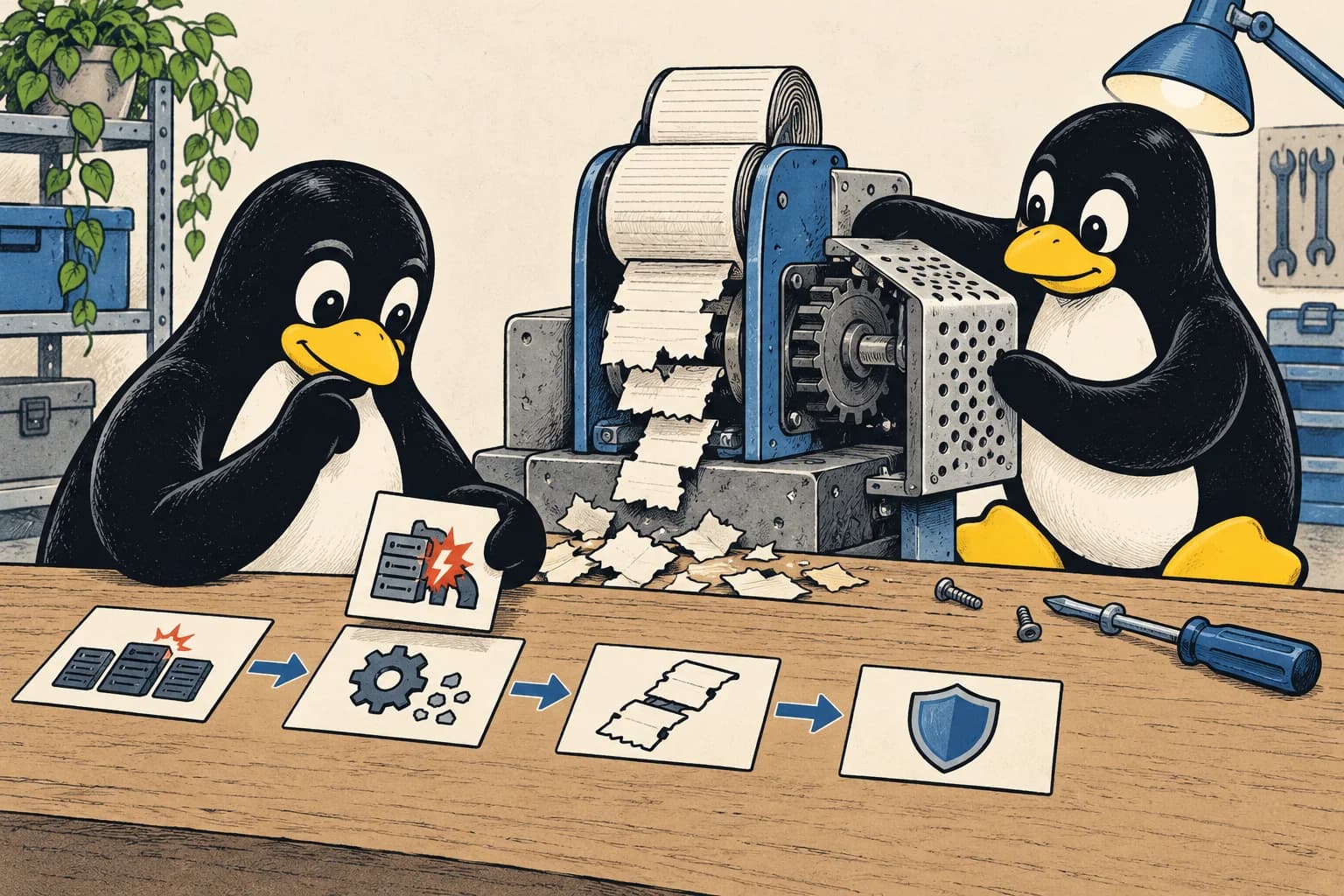
- 01What happened?
- 02What allowed the harm?
- 03What should change?
What does “blameless” mean?
Blameless means the review investigates why a decision made sense with the information available at the time, instead of stopping at “someone made a mistake.” Suppose a report says, “The person responding selected the wrong setting.” That records an action, but it leaves the important questions unanswered. Did the options look similar? Was the setting described clearly? Could the software have rejected an unsafe choice before customers were affected?
A blameless review records human actions and their context together. Saying someone was careless does nothing to explain how the same mistake could be prevented next time, and it teaches people to hide what happened rather than report it.
Blameless does not mean nobody is responsible for anything. People still take responsibility for improvements. An engineer can own a new validation check without being blamed for the original failure. Validation means checking that an input or result meets the intended rules.
Which problems deserve a review?
A review is worth holding for any incident with significant customer harm, wrong records, recurring failures, difficult recovery, or a useful near miss. An incident is a service problem requiring a coordinated response. Teams should agree on their review criteria before an incident happens, so the decision is not made in the tired aftermath of one.
A near miss is a problem that could have caused harm but was caught or avoided. It can reveal a weak protection before a larger failure occurs, which makes it one of the cheapest lessons you will ever get.
Also examine important failures that produced no alert. They may show that the team cannot detect part of the customer experience. A modest failure that repeatedly consumes hours deserves attention too, even if no single occurrence was dramatic.
Keep the review proportionate. A short account may be enough for a small event; a complex failure may need several people to reconcile evidence. An unnecessarily heavy process discourages people from reporting things at all.
Why look beyond the change that started the incident?
The change that triggered an incident is only one part of the explanation; the review also has to ask why the protections around that change did not catch it. Assume this fictional TicketDesk review establishes the following. A new version created more confirmation work for each booking. Its canary, the small group used to test the version first, barely exercised the affected booking type. The dashboard showed only the overall checkout success rate. The rollout expanded, confirmations waited longer, and outdated recovery instructions delayed the response.
The triggering release explains how the problem started. The team also needs to understand why the limited test missed it, why expansion continued, and why the recovery instructions were wrong. Fixing only the release leaves every other weakness in place for the next release.
A release gate is a check that must pass before a change reaches more users. Here it lacked a relevant measure of confirmation delay and a stop condition for the affected group.
These are invented findings for practice. In a real review, support each one with records, measurements, or other evidence. Be careful not to let an early guess harden into the accepted explanation.
What should the report contain?
A postmortem report should contain the customer impact, a timeline of observations and decisions, what worked and what failed, and a set of concrete actions. Start with the incident and its impact. Explain which tasks failed, how long the impact lasted, and what happened to delayed confirmations or affected bookings. State how the estimate was made and what remains unknown.
Build a timeline of observations, decisions, and changes. Failure, detection, mitigation, and recovery can happen at different times, and the gaps between them are often where the lessons are. A mitigation reduces immediate harm. If new booking errors fall at 10:16 but confirmations catch up at 10:35, preserve both milestones.
Describe what worked as well as what failed. A setting that quickly disabled the new behaviour may have helped, while a missing measurement delayed verification. Future responders can use both findings.
Preserve evidence that might otherwise expire, following the team's normal process. Keep sensitive customer information out of broadly shared reports when it is not needed to explain the mechanism.
How do you turn a finding into a useful action?
A useful action names the change, its owner, its priority, a target date, and a check that shows it worked. “Improve monitoring” fails that test because it does not specify a finishable task. The check at the end is called an acceptance test.
For example, Maya, a fictional release lead, could add confirmation delay and affected-booking coverage to the release gate before the next confirmation launch. Replaying the incident's workload should then demonstrate that the check stops expansion before the agreed impact limit.
The replay tests the intended protection. Merely showing that a chart now exists would be weaker evidence, because a chart nobody looks at protects nobody.
Choose a manageable set of actions and give people time to complete them. A long list where everything is urgent makes prioritisation harder, and most of it quietly never happens. Aim actions at the observed weaknesses in prevention, detection, exposure, or recovery.
How do you know the review helped?
You know the review helped when its actions have been implemented, the new protections have been tested, and later incidents show fewer repeats or quicker recovery. Follow actions through to completion rather than filing the report and moving on. A practice failure, or drill, can show whether the release check now catches the known problem. The reliability-testing lesson explains how to limit such an experiment and check its results.
Share findings with people facing similar conditions. An incomplete measurement or an unclear responsibility can affect other services too.
Use the notes from incident management to preserve observations and decisions. The report records the investigation. Check that its proposed changes actually reach the service and produce the intended result.
Exercise: replace “be more careful”
Rewrite this action: “The responder should check the setting more carefully.”
Begin with what made the wrong choice possible. If an invalid setting passed review, propose a check with a reproducible example that would have failed. If the person lacked context, improve that information and test whether the workflow becomes clearer. Training may help too, as long as you can explain what it will change.
In an interview, connect your reasoning from the finding to the action and its acceptance test. Another engineer should be able to understand what to implement and how to decide whether it is finished. That is the standard every action should meet.
Quick answers
What is the purpose of a blameless postmortem?
The purpose is to understand why an incident happened and change the system so it is less likely to recur, without punishing the people involved. Blame makes people hide information, and hidden information cannot be used to improve anything.
What makes a good postmortem action item?
A good action item names a specific change, an owner, a priority, a target date, and an acceptance test that shows it worked. “Improve monitoring” is not an action item; “add a confirmation-delay check to the release gate, verified by replaying the incident workload” is.
Should every incident have a postmortem?
Not every one, but any incident with significant customer harm, wrong records, a difficult recovery, a recurring pattern, or a useful near miss deserves one. Keep the effort proportionate to the event so that reviews stay useful and people keep reporting problems.